Questions & Answers

How do I choose between Singlemode (SM) and Multimode (MM) fiber?
Singlemode fiber is best for long-distance, high-bandwidth applications (such as telecommunications or data center backbone connections), while Multimode fiber is suitable for shorter distances within buildings or campuses, providing cost-effective, high-speed connectivity. Although, singlemode has gained popularity for shorter runs since the technology such as SFPs and switches has improved and the cost of the equipment has decreased in recent years.
Are these assemblies customizable?
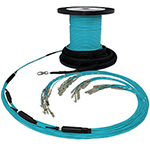
You can choose any connector type, cable length from 10 feet up to 5,000 feet, and strand count based on the fiber type (multimode OM1, OM2, OM3, OM4, OM5 or singlemode). A pulling eye can also be added for easier installation. Contact us for additional customization options.
Are indoor/outdoor assemblies flexible enough for data center use?
Absolutely. Despite their rugged construction, they remain flexible enough for routing inside data centers, telecom closets, or office environments once the cable enters the building.
Are indoor/outdoor assemblies flexible enough for tight bends?
While they are more rugged than indoor-only cables, they remain flexible enough for routing around corners and through cable trays without compromising fiber performance. Always check the spec sheet on your assembly for the maximum bend radius.
Can I combine multiple assemblies if I need a longer run?
Yes, you can couple multiple pre-terminated fiber assemblies using adapter panels or adapters (aka couplers) and patch panels to extend your fiber run.